
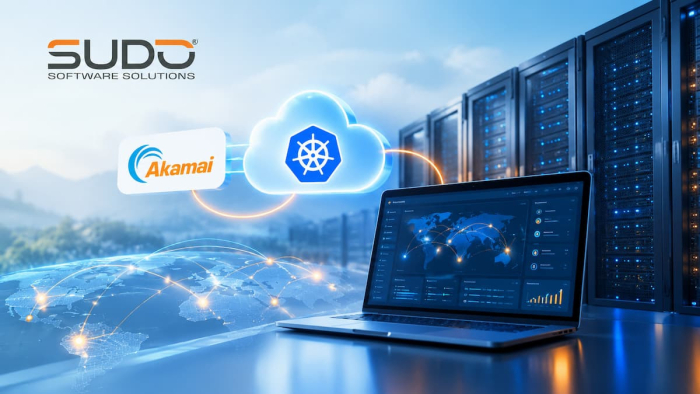
Standardizing containerized cloud infrastructure on Akamai Connected Cloud (Linode Kubernetes Engine & Object Storage) to power 1,000+ client systems across Germany, France, and Vietnam — cutting deployment times by 50% and reducing cloud TCO by 40%–60%.
As enterprise e-commerce platforms, ERP systems, and mission-critical web applications scale internationally, cloud infrastructure architecture directly determines system reliability and long-term operating margins. This case study examines how Sudo’s DevOps and infrastructure engineering team standardized a high-availability Kubernetes architecture serving more than 1,000 organizations across Germany, France, and Vietnam — an engineering milestone independently verified and published by global cloud and cybersecurity leader Akamai Technologies (NASDAQ: AKAM).
Project overview
- Project title: Multi-region Kubernetes (LKE) cloud infrastructure & DevOps standardization
- Architecture & DevOps lead: Sudo Infrastructure & DevOps Engineering Division
- Core cloud partner: Akamai Connected Cloud (Linode)
- Official Akamai verification: https://www.akamai.com/resources/customer-story/sudo
- Operational scale: 1,000+ client systems across Germany, France, and Vietnam
- Scope of Sudo’s engineering:
- Containerization and cluster orchestration using Linode Kubernetes Engine (LKE)
- Static asset decoupling and multi-node backup replication via Akamai S3 Object Storage
- Automated CI/CD deployment pipelines and zero-downtime release orchestration
- High-concurrency database tuning (MySQL/PostgreSQL, Redis) and edge DDoS mitigation
Background and engineering challenges
Since 2015, Sudo has engineered and operated custom web platforms, e-commerce systems, and enterprise applications for over 1,000 clients across Vietnam, France, and Germany. As concurrent user traffic and data volumes expanded across both European and Asian markets, relying on traditional single-server setups or legacy hyperscalers (such as AWS and Google Cloud) created three critical bottlenecks:
- Unpredictable hyperscaler egress costs: High outbound bandwidth charges and complex multi-tier pricing on legacy hyperscalers inflated monthly operating costs whenever client platforms experienced traffic surges.
- Environment drift and manual provisioning overhead: Managing individual virtual machines manually created configuration discrepancies between development, staging, and production environments — slowing down release velocity.
- Strict European latency and data residency mandates: European workloads in Germany and France required sub-10ms regional latency and strict EU GDPR / Swiss FADP data sovereignty, while APAC workloads required rapid response times from Singapore and Tokyo hubs.
“Cost optimization and predictable cloud economics have always been critical for us and our clients. At the same time, we needed enterprise-grade security and consistent uptime to protect mission-critical customer workloads.”
— Nguyen Cao Tu, CEO of Sudo, featured in Akamai’s global customer story.
Sudo’s architectural solution on Akamai Connected Cloud
To achieve both high-availability performance and predictable Cloud FinOps, Sudo partnered with Akamai Technologies to re-architect and standardize its cloud infrastructure on Akamai Connected Cloud (Linode) across three core technical pillars:
1. Container orchestration with Linode Kubernetes Engine (LKE)
Sudo transitioned application workloads from standalone virtual servers to containerized microservices orchestrated by Linode Kubernetes Engine (LKE):
- Zero environment drift: Standardized Docker containers and Kubernetes manifests ensure 100% parity between development, staging, and live production clusters.
- Automated horizontal scaling and self-healing: Kubernetes automatically scales compute pods during peak commercial campaigns and replaces unhealthy containers instantaneously without human intervention or service downtime.
2. Decoupled storage architecture with Akamai Object Storage
Static media, large application assets, and rolling disaster-recovery snapshots were decoupled from primary compute nodes and migrated to S3-compatible Akamai Object Storage:
- Offloaded over 70% of static read/write I/O pressure from core transactional SQL/NoSQL database servers.
- Simplified cross-region backup retention and automated disaster recovery verification.
3. Multi-region edge deployment and network-layer DDoS defense
Leveraging Akamai’s 40Gbps global fiber backbone and true KVM hardware virtualization, Sudo deployed regional clusters directly adjacent to end-user markets:
- European GDPR & FADP compliance: Workloads serving DACH and European users are deployed in Tier-3+ facilities in Frankfurt (Germany), Amsterdam (Netherlands), Paris (France), and London (UK), delivering sub-10ms latency and full European data residency.
- Asia-Pacific hubs: Workloads serving Vietnam and Southeast Asia operate out of Singapore and Tokyo datacenters for sub-25ms regional responsiveness.
- Automated DDoS scrubbing: Built-in network-edge traffic scrubbing mitigates volumetric DDoS attacks before malicious packets reach application clusters.
Measurable engineering and business outcomes
Standardizing on Akamai Connected Cloud delivered immediate, audited improvements across Sudo’s delivery pipeline and client operations:
- 50% reduction in deployment time: Automated CI/CD pipelines paired with LKE container orchestration cut production release and server onboarding times in half.
- 40%–60% lower cloud infrastructure TCO: Predictable compute pricing, 100% Enterprise NVMe SSD storage, and generous bundled outbound bandwidth substantially lowered monthly cloud spend compared to traditional hyperscalers.
- 99.99% infrastructure uptime SLA: Resilient Kubernetes clusters and proactive 24/7 telemetry safeguard continuous operations for 1,000+ client systems across Europe and Asia.
How European and international enterprises benefit from Sudo’s cloud partnership
Operating through our Swiss legal entity in Killwangen, Aargau (Phung Beauty & Tech GmbH — UID: CHE-474.361.935) alongside our R&D centers in Vietnam, Sudo delivers turnkey Akamai (Linode) cloud infrastructure and DevOps engineering to B2B clients:
- Official Akamai EUR rates with zero markup: Transparent B2B invoicing in EUR via SEPA transfer, while you retain 100% root SSH and native Akamai Cloud Manager sovereignty.
- Free zero-downtime migration (worth €250+): Sudo’s Senior DevOps engineers migrate your existing applications, databases, and SSL configurations at zero onboarding cost.
- 24/7 Managed DevOps Care: Optional ongoing server management (from €25/month) covering OS patching, Redis/Nginx caching, WAF hardening, and 15-to-30-minute SLA incident rescue.
👉 Verify the official publication on Akamai’s website: Read Sudo’s Customer Story on Akamai.com
👉 Explore European server plans & DevOps SLA: Linode (Akamai) Cloud Server & Managed DevOps